

White flag
a short story

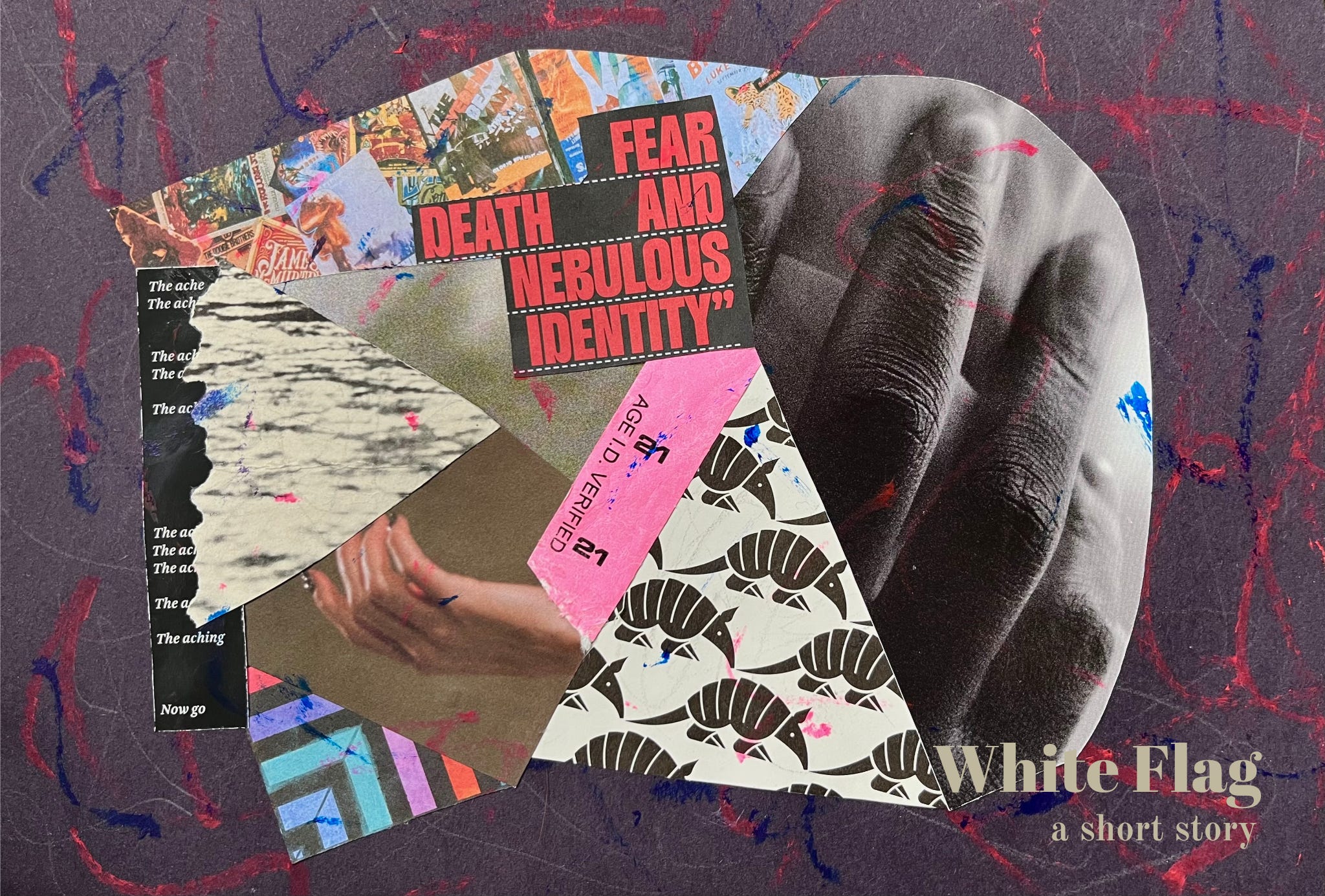
It was around golden hour, that frighteningly divine time of day when the sky comes down to convene with mortals for a short spell, that I passed the squirrel in the road, crushed but somehow not quite dead yet. The bulky center of its rodent body was flattened into second dimension, yellow pink guts evacuated onto the pavement, but there was its big tail up in the air flapping and whipping, all the honey light sparking in its mottled fur. The car rolled past, an object in motion, and then it was just a flag of surrender snapping in my rearview mirror.
That magic hour had passed by the time I checked into the hotel. The sky left the plane of earth and was busy bruising the atmosphere blue. The air in Providence—the smell and the feel was too personal to describe in simple terms—it smelled like being nineteen and teetering on the edge of something dangerous and unimportant. I couldn’t shake the notion that someone was waiting just around the corner to push me in one direction or another and I wouldn’t know which until I landed on my ass about it.
For the first thirty minutes or so I sat in my hotel room testing the gaudy duvet with my fingertips as if I could spend the whole night defining its texture, knowing very well that I’d be drawn out into the night soon enough. I put my shoes back on and walked down to my old liquor store, half expecting them to recognize me a decade later but of course those employees had moved on with their lives in the intermittent time or their lives had ended altogether. I bought a fifth of vodka and downed it on the bed with all the lights off until I could no longer feel the threaded canyons of the duvet cover with my senseless fingers.
Past the heavy curtains Providence winked and pulsed, almost looking like a real city without a daytime sky to diminish it.
The morning greeted me with an inner knocking at the temples. Sour breath fermenting on my tongue. My gut, sharp. I tried to draw up the covers against the slight chill in the air but I’d fallen asleep atop the duvet in just my hoodie and my jeans. I spent a while under the showerhead willing it to get just a little bit hotter and chase away the chill but it never quite got there. Twisting the shower knob anyhow like I might be able to trick it.
Dressing took a while. It had been, oh, I don’t know, six years since my last funeral and the suit hardly fit me anymore and I hardly remembered all the basics, tying the tie, no not like a noose, like a normal person wears, scraping the brain cells together to act like a sentient being. My belly bulged against all those tentative shirt buttons and I slapped the fat with both hands in a futile attempt to hedge it in. No such luck.
At the reception desk I put on my best grieving face which wasn’t so hard given that I was grieving and I knew I must look weary from my liquor slumber with all my premature grays streaking my stupid balding head and of course there was the ill-fitting suit of it all.
“Hello,” I said. “And good morning.”
“Good morning,” the woman replied, grinning a receptionist grin behind her computer monitor. “How can I help you today?”
“The shower in my room,” I said. “It just won’t get hot enough.”
“I’m sorry to hear that. I can send someone up today to take a look–”
“That’s not necessary,” I said. “I’m–well, I’m going to a funeral today. An old mentor of mine passed, so…”
She let the sentiment hang in the air, waiting for me to go on and when I didn’t she said, “I’m so sorry for your loss, sir. I imagine a hot shower would be…desired at this time.”
“Well, it’s too late for that.” I laughed in a way that suggested I didn’t find it very funny. “I leave early tomorrow so I won’t have time for another. I was just hoping–well, a discount would be lovely, twenty or thirty or forty dollars off my stay, I think would be good right now. For my grief, I mean.”
The receptionist smile peeled back into a curt one, the smile you offer an asshole to let him know he’s being an asshole. And I smiled back in a way that said I know I’m being an asshole and I’m sort of sorry about that but not sorry enough to stop being an asshole. It’s basically all I know. And we went on like that for a while, being assholes to one another, with one of us being right and the other being the customer until she gave in and refunded me twenty five dollars which should show on my bank statement in three to five business days, etc. and I thanked her and asked for a tissue–for the grief–which she handed to me using two petite fingers. It went into my breast pocket and I left with a spring in my step, having accomplished something very stupid.
The drive down to the funeral home was a challenge of keeping my eyes on the road and only the road, the hypnotic strobing white lines the center of my vision and nothing else. Impossible, though, to avoid the stunted city entirely. All the old streets and all the ways in which they were new. An old boyfriend broke my nose on that now pristine street corner. I threw up in that park at the feet of that far too recently removed racist statue. I got coffee at that defunct Dunkin to combat many a hangover (the hangover always won). The chill was still in my bones, the sharp and needling fear that I might see someone I once knew and they would either recognize or not recognize me, each fear equally weighted.
I pulled into the parking lot late and the place was already overflowing, an actual line of black-clad mourners spilling out the funeral home’s open double doors. “The fuck,” I muttered. The guy was basically homeless, where did all of these people come from? The lot was full so I had to pull back out and park down the street at a meter I did not pay for, walk a mile, sweating under the high white sun, yet still mercilessly cold. Joining the line in the way way back, I asked the woman in front of me, dressed like a widow in a lacy black dress with all her dark hair carefully done up and dark makeup gaudy around her big eyes, “How did you know Barry?”
“He saved my life,” she said. And then I asked the person who lined up behind me and got pretty much the same answer and because that was also my answer I got the idea that maybe he was not mine in the way I’d thought. Given the size of this line, it seemed he was everyone’s.
And it was a laboriously slow line. It appeared that we’d be stuck outside for a while and so I asked the woman, whose name I did not know but who I was calling Elvira, “would it be disrespectful to smoke a cigarette?” like I was joking even though the paper carton and lighter were already in my hand. And Elvira wrinkled her gothic eyes and smiled at me sort of sadly, which was patronizing enough that I had to light a cigarette about it. I blew the smoke up in the air and ignored the people scoffing behind me. The nicotine eased something I didn’t care to identify.
That smell though, the city or my memory of it, would not dissolve. It was tapping on my shoulder, asking me to turn around and look it in the face. But I’ve never been one to do what I was told, it was something Barry found funny about me, something that intrigued him because he liked a challenge, maybe required a challenge in order to work his magic, and he was always trying to find loopholes around my indignance, trying to trick me into being a better person by making me believe it was my worst traits he was encouraging and I never knew I’d been tricked until it was too late. Until I was better against my own will.
I called him Uncle Barry. He tried picking me up at The Dark Lady when I was 24 on my fake ID, 20 in reality, and when I asked how old he was he said I’m old enough to know that question means you’re too young for me. Then he put his arm around my shoulder and stretched the world into four dimension. It was the way he saw things. He could follow a person’s sightline and understand from it their every desire and the ways in which they ran from those desires or chased them down dark, desolate holes into isolation. When a door opened he knew whether or not there was anything worth chasing on the other side. When I was lost, standing in place, he turned my chin up toward the light and revealed something I hadn’t known to look for. Thinking of him in that line, as I rarely let myself think of him, I found it difficult to square him as a real person and not some mischievous yet benevolent deity who had visited me for a time. He was a behemoth, a person too incredibly unique to have ever been real. That unrelenting individuality was all a smokescreen, I imagine, to hide his own deep turmoil which I’ve always told myself I couldn’t see, so deep was I in my own shit, but I must have known, as everyone in his circles must have known, there was a pain in him so great it was impossible to look at or even approach, like an event horizon it might suck you in with no room for escape, so we let him concern himself with our problems, our simple and fixable problems and I felt I was doing something good for letting it happen. As if my life sustained him.
On the outside, it made such little sense, our friendship. He was a black homeless man in his late 50’s when we met, while I was sheltered and white, not from any significant amount of money but enough to attend RISD and fuck off often while doing so. I was gay but he was a faggot, or a queen depending on the night. He lost twenty-seven friends to AIDS in the 80’s and lit a candle for each of them every Sunday night. I’d never said the words ‘I love you’ to a friend. He helped me quit the bottle once, and then twice, and then three times. He had a sister who was murdered and he’d spent eight years in jail for attempting to kill her murderer. All of these things I knew about him because he shared them like folk yarns, with a glint in his eye that said he liked the shock they produced though the near fictionalization of the events suggested he was maybe as afraid of all he’d endured as I was afraid of ever having to endure it myself. I was just a simple burnout alcoholic, just a lonely man burying my loneliness in the hard arms of whatever man was available. These simple, fixable problems of mine.
How could he have lost so much and kept grinning that rotted tooth grin while I’d only just lost him, after not knowing him for so long, and felt my legs were going to buckle under me and bring me to some disgusting, sacrilegious form of prayer. My reverie carried me too far and too deep within. I needed a drink but there was none available and the line just staggered on into the afternoon. Unable to entertain myself or numb the lack of entertainment, I asked Elvira, a bit too begrudgingly, how her particular story of being saved had gone. She appeared reluctant at first to share her story with a stranger, or maybe just with me, but a cloud crossed paths with the sun then, softening all the shadows and harsh lines on our faces and she maybe saw something more open in me, a true disciple of Barry. I shivered and shook in the momentary shade.
“It was 2008,” she said, and I could hear Barry immediately in her voice, in the narrativizing of a life, the packaging and redistribution of hardship. A way of bearing it. Hadn’t managed to pick up that particular skill myself. “I was living with a man while I went to Brown. Didn’t have to pay rent, just chip off some of my dignity for him, that sort of thing. He was awful to me, very abusive, though I couldn’t call it that then, internally I just couldn’t face it. Externally, though, I was drinking all the time to endure it and started missing classes, letting my studies lapse. I was there on a very delicate and particular scholarship, otherwise I never could have afforded it, and the more they threatened to pull the scholarship the more I thought I didn’t deserve it in the first place. I was totally resigned about the whole thing, I couldn’t even remember why I was going to school in the first place. So, my grades dropped, the scholarship got pulled, I had no job, no money, I couldn’t live anywhere but with this man I was so dependent on. Well, one night, it was summer, I remember us both in shorts, we got into a fight outside a bar, which wasn’t uncommon but this particular bar happened to be on the corner where Barry was camping then and he intervened–I remember him putting on this voice, way deeper than his real voice. He could just sense things about people and he knew that this man would be afraid of a deep-voiced black man while I wasn’t bothered. This man turned and ran. Barry said to me, you’re not going home, that is not your home anymore. And I trusted him, immediately, I just thought, well it’s not my home, is it? Never was. He brought me to a shelter and helped me get a job and get sober and–I mean, I could go on. I wouldn’t be alive if we hadn’t happened to be on his corner that night, but I felt it was meant to happen, you know?”
I did know. Elvira asked for my story in return but I’d already decided I couldn’t speak it out loud. It wasn’t so dissimilar to hers, anyhow. I was just as lost, wandering in a dark that I hadn’t known was darkness. Dragging myself through a prestigious design program, wondering how I’d got there and how I could possibly end up anywhere else with such talentlessness in my blood–both my mother and father were failed artists, content enough in their fallback careers, but quietly putting their hopes on me to carry the dwindling torch and make a name for myself. But I wasn’t creative, or I didn’t care for creation as much as I cared for destruction. The only pleasure I derived came from letting ostensibly heterosexual men come to me under the guise of offering creative tutelage with both of us tacitly understanding only a violent, shameful sexual relationship could possibly come from it.
I was at the club that night, The Dark Lady, because a man, a graying metalwork professor with a bountifully hairy chest, had ended things that morning, he was going back to his wife, ha ha ha–that was me, laughing in his face, that was my attempt at mustering a sense of power, to wield shame over his head the way he had mine, but those dynamics I had with discreet men all centered around the fact that they could look away from their shame effortlessly while mine occupied my whole field of vision at all times. Barry had sensed that in me, I think. That he’d found me in a liminal state where I was beginning to understand how much I was ruled by self-loathing and how unfair it was to have my arm twisted to capitalize on that loathing. He showed me a gentler way of being. It felt like pure coincidence that our paths had crossed when they did, but what do I know–what does anyone know about angels and inevitabilities?
“It’s hard to maintain it, though, isn’t it?” I asked Elvira. “He saves you and it’s like, then what?”
Elvira tilted her head, curiously. “I suppose. He was only in my life for a few months, really, before I started planning another path. In the shelter I met a lot of incredible women and they saved me as much as he did, maybe more. Barry was like a life raft, you know? Good in an emergency, but really only a temporary salve for a terrible situation. You still have to make it to shore. You have to paddle.”
The thought of that made me nauseous so I lit another cigarette and Elvira sighed and abandoned me to my own thoughts again. The line shuffled along and I found myself suddenly grateful for its meager pace, unwilling or unable to imagine what would happen after–returning to the hotel, stopping for liquor on the way, waking in the morning even colder than I was now, returning to my life in a different city with the same problems. I couldn’t remember any longer why I’d left Providence and my life raft behind. It began to grate on me, I think, that he wanted my life to develop, that it had to look like more than quitting the drink and maybe dating a decent man every once in a while. He’d say to me, on hot nights by the Providence River, watching the smoke stacks cough over the horizon, You haven’t found your life yet, amigo. You’ve only found what it isn’t. Then he’d asked me to dance and so I would dance like a fool for him, just to hear his laugh blanket the city. It wasn’t a joke to him, though. It was simple joy.
No, I think I was at least trying when I left. I graduated RISD with not terrible grades and I interviewed with an architecture firm up north as though it genuinely interested me and I told Barry, I said, look here’s a man planning his life, isn’t that something? He could see right through it, the meager struts I’d propped up and how they could not constitute a stable life. Don’t you go running where you know there’ll be nobody to catch you if you fall, he said, and then I’d given him no choice but to watch me go. To know that he was right would bring him no joy. The new city hadn’t welcomed me with the ease I’d expected and when the usual habits reared their weaselly little heads I made no effort to find another life raft. I slipped back into the deep, the unending deep of decisive listlessness. That I could still be alive after a decade underwater without popping my head up for air, yet Barry was the one who died, Barry who loved life in spite of much worse hardship—it was no wonder my self-loathing was so inescapable.
Finally, I was welcomed through the open doors into the funeral home. “Lord, that sun,” Elvira said, but I already missed it. The place was chill and damp, like an unfinished basement, carpet unforgiving beneath my feet, the line moving seemingly faster but my fear of seeing him only growing larger; seeing his dead and slackened face which could not admonish me with a smile, his bloodless arm which could not lasso me back into the world, his senseless brain which had always known the way but could no longer show it to me so I might ignore it. I thought, in my coldness and my aching, I hope this goes on forever, the way I drink to maintain the drunkenness, I hope this line never ends and I never have to face myself and the life I’ve let happen to me.
It was open casket. Elvira stood over him with her hand to her heavy chest and tears rolling down her cheeks, the thinnest smile on her thinnest lips. Then she moved on to greet the–family? I didn’t know these people waiting on the other end of Barry’s death. What was I doing here? I mooched off this man in his life, gave him nothing back and now I wanted, what, a stranger’s hand on my shoulder, someone to see through the hardened exterior to the bursting heart in my chest? Someone to see my pain with clarity and to redirect it somewhere useful—I wanted his words and his easy grin to guide me again, only now that I could not have it did I feel ready or hopeless enough to finally listen. I know nothing of angels and inevitabilities.
My cold heart shivered in my chest as I stepped forward in my scuffed and stinking dress shoes with each hand squeezing the blood from the another at my belly and the white light of surrender swarming my vision and–oh—oh! Ha. I startled myself with a laugh. All I could do was laugh. All I could do was let Barry surprise and entertain me one last time. He’d had his holy body done up in old school drag. Black Berry was her name, a Providence drag staple, though I’d only seen her perform once. She liked thick, red lips and big wigs teased up to the ceiling and gowns that swept the floor, gowns that made drama. She danced to Tina Turner the night I saw her, just before I left the city, somehow making that cheap wig come to life under the flat bar lights, making every reluctant foot tap and every set of lips turn up toward heaven. Now, laid out in a rhinestoned scarlet gown with breasts contoured and heavy eyeshadow, in death, as he had been in life, Barry appeared full of that ineffable thing; joy, an earned ease, grinning in the face of utter despair. Consigned forever to a coffin in the earth, he thought: Let me look beautiful, let them know I went out without compromise. This is the life I lived and I will not apologize for it.
I trailed two fingers along the deep red silk sleeve of his gown and though I didn’t feel anything as mystic as his spirit in the room or his voice in my ear, something did release—a knot between my shoulder blades, a decade of pain. I wiped the tears on the tissue in my pocket and shook hands with his family–a recent adoring boyfriend, a daughter he’d adopted after I left the city, an aunt who had housed him as a teenager when life with his parents was no longer tenable. I didn’t dare impose my own grief onto these people who certainly knew him better than myself. I merely told them what others had been telling them all day long, what I wish I’d told him in life–Barry was a force, Barry showed a person the fabric they are cut from in a brilliant light, Barry saved lives—Barry saved my life and I’ve made such little use of that large kindness. Stepping back into the high afternoon sun, I felt the warmth of the day alight on my skin. Turned my chin up to greet it.
I parked my car at the hotel and walked back down to the liquor store with my mourning suit splitting at the seams. Bought a bottle of red wine, a rich merlot. I clutched it hard to my chest all the way back and then in the lobby I held the bottle out to the receptionist I’d berated that morning. She peered up at me with her knowing receptionist eyes, skeptically, as though I might pull it from her hands at the last second—gotcha, ha ha ha, nothing ever changes, fuck you fuck me fuck us all, if I can’t be happy then no one can.
I said only, “Don’t spend it all in one place,” and I winked and I moved along. Someone else was sat there when I checked out the next morning so, I don’t know, maybe she poured it out in the kitchen sink, maybe she gave it to a friend, maybe she reported it to the police—oh my god this old fat asshole, it was awful—but I think she probably just went home and poured herself a glass, sat in front of the television sipping itslowly, thinking to herself, well at least I got something out of it.
What do I know. I’m just the asshole.
The sun was shy and pale on the drive back north. I found myself, on that one particular stretch of highway, looking for the squirrel in the road but it was gone, or I missed it. Maybe scraped off the pavement with a shovel and loaded into the back of a truck. Maybe snatched up by the talons of some great descending bird of prey. I thought, with only a pinch of optimism, that maybe it managed to live. Looked around at its guts all exposed and steaming on the pavement and said, oh dear, that’s no good, and gathered everything up and went somewhere to put himself back together. A little banged up and battered but pattering on anyhow, tail still whipping, never ceasing.
maybe someday I'll see you again / in a field, a war, a kingdom of sand
I have a novel. It’s called Mars in Retrograde. You can buy it here. Love you like for real. jw.


The hotel discount scene is the one that got me. Knowing you're being an asshole and being sort of sorry but not sorry enough to stop. That's grief doing what grief actually does. It doesn't make you noble. It makes you petty and honest at the same time. Really well crafted, James. Beautiful piece.
JW has done it again 🩷 most emotionally resonant writer on the dang platform